
ASRM 2026: Fertility Tech’s Next Opportunity Is Connecting Care

As care becomes more complex, innovation focuses on connecting the journey.
As the fertility field's largest annual gathering, the exhibit floor of ASRM (the American Society for Reproductive Medicine) offers a useful snapshot of where the industry is investing, where it is consolidating, and where gaps remain.
Last year, one of the most interesting questions was: What’s new? AI, robotics, and diagnostics applications were creating specialized solutions for every point in the fertility journey. (See our 2025 Market Map).
This year, a more revealing question may be: How does it all connect?
Our review of the 237 ASRM 2026 Expo Hall participants across 22 subcategories points to a market in transition. Patient-facing applications are increasing in both quantity and scope, clinics are operating within larger networks, and the infrastructure in care delivery remains dense, with lab and embryology as the largest segment.
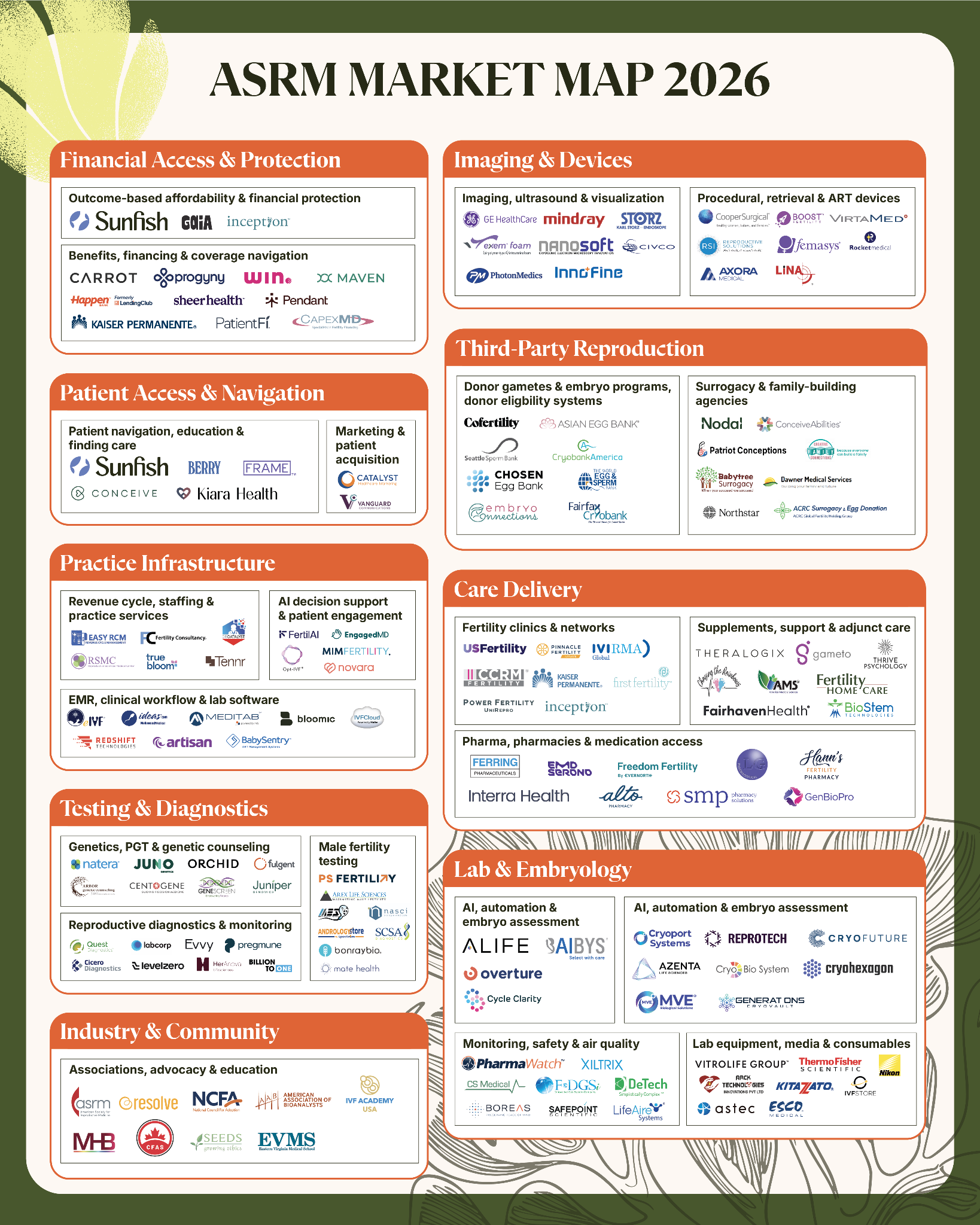
The fragmentation tax is catching up with fertility tech
In January, we hypothesized that fertility technology is moving from point solutions toward embedded platforms. Our analysis of 160 venture deals from 2020 through 2025 found a “barbell” market: significant early-stage experimentation, with most capital concentrated among larger companies that connect data and patient access (Sunfish).
ASRM 2026 offers another view of that shift.
Some of the clearest contractions when compared to the 2025 map appear among narrow patient-facing and single-function categories. In parallel, practice operations, clinical software and lab infrastructure remain prominent.
Every point solution may address a real problem, but it can add another vendor or handoff. As clinics and networks consolidate, they gain more incentive to reduce disconnected workflows.
AI is consolidating point solutions
AI illustrates this transition well. Embedding AI into clinical workflows isn't new; that shift is well underway. What's new is that point solutions are no longer enough. Clinics and patients increasingly want solutions that bring multiple features and data together, with AI working across all of them. In September, OpenAI announced an integration that lets clinicians query Epic patient records through ChatGPT (OpenAI, 2026). When AI can work across a patient's full record, single-purpose tools face competition. Dr. Alexander Kucherov, a reproductive endocrinologist at Illume Fertility, notes:
“Over the past year, AI has become a much bigger part of the fertility conversation, especially in the IVF lab, with new tools focused on embryo assessment, sperm selection, and lab operations. Because fertility care is already emotional, costly, and complex, these tools will need to demonstrate that they help in meaningful ways, whether through improvements in embryo analysis, enhanced efficiency in lab protocols, clearer counseling, or an increase in positive patient outcomes, ideally evaluated through randomized controlled trials.”
Early-stage innovation is still present. ASRM's New Horizons pavilion creates visibility for emerging companies. But the bar has shifted: they will have to show how they connect to broader platforms and data, not just solve one problem.
Financial access is becoming financial infrastructure
The financial category is changing as well. It appears narrower than last year, but its composition is shifting from traditional financing and benefits toward outcome-oriented models.
Even our taxonomy changed. “Outcome-based affordability and financial protection” warrants its own category. Historically, the central question was: How can a patient finance a treatment cycle? Increasingly, it is: How can companies provide greater financial certainty across an uncertain treatment journey?
This requires thinking beyond one transaction to total costs, treatment continuation, outcome risk and the guidance patients need to inform decisions. Dr. David Sable, a reproductive endocrinologist and life sciences investor, sees this shift as part of a larger change in the field:
"There are two trends I see: first movers looking to disrupt risk management and limit patients' financial exposure, and an industry-wide commitment to better collecting and using data. Together, they point to an evolved ecosystem that creates capacity to meet true need, where anyone who needs IVF doesn't have to think twice about whether it's accessible, available and affordable. The hard work is being done now."
The next platform advantage is continuity
Even as organizations consolidate, care remains fragmented. A patient may move through education, diagnostics, financing, medication, a clinic, a laboratory and multiple treatment pathways. When each component works independently, the overall experience feels disconnected.
The strategic opportunity is not simply aggregation. It is continuity: preserving context across stages, reducing handoffs and helping patients and clinics understand what comes next.
This is especially relevant at ASRM. Companies are not only competing to introduce new products; they are competing to become trusted partners to clinics and networks. The strongest platforms will demonstrate that they can make the patient experience more coherent. Raghav Mishra, Sunfish VP of Product, notes, “A major focus for us over the last year has been strengthening our existing solutions while expanding our reach earlier in the family-building journey. We’ve created a more comprehensive experience that supports patients from initial planning and beyond treatment, while giving patients and providers greater visibility and support at every stage.”
Building for the market that is emerging
Last year, Sunfish’s goal at ASRM was definitional: to demonstrate that we offered more than lending, including personalized fertility packages and financial protection.
This year, the question is value: Where can we provide support that other solutions do not?
Sunfish has been building toward the shift now visible across the market. Sunfish Starts supports people earlier in their planning process, while our IVF and Egg Freezing Success Programs combine cost transparency, financial protection and personalized guidance around treatment. Together, these products reflect a broader approach that begins before financing and continues through the entire family-building journey.
For Sunfish, ASRM is an opportunity to establish that value alongside larger benefits and navigation platforms and show how our model can scale across additional products and pathways.
As fertility technology consolidates, we see the greatest opportunity in connecting care, enabling patients to move forward with greater clarity and confidence.


